
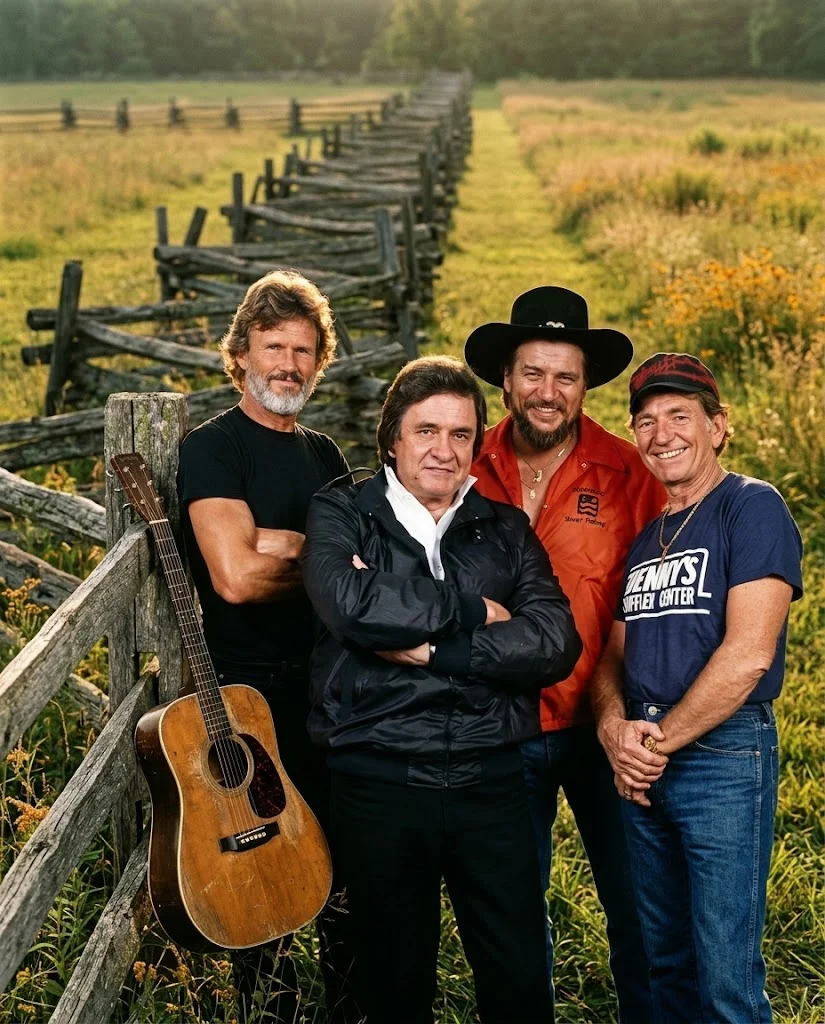
In 1985, four legends of country music walked into a studio with no intention of chasing trends or rewriting their rebellious pasts. Johnny Cash, Willie Nelson, Waylon Jennings, and Kris Kristofferson — the Highwaymen — came together to record a song that would become a quiet anthem for growing old with grace. Their collaboration on Guy Clark’s ‘Desperados Waiting for a Train’ was not just a cover; it was a shared autobiography, a reflection of lives lived on the edge and the wisdom earned through survival.
The song’s narrative, originally about a young boy’s admiration for an aging Texas oilman, took on a deeper resonance in the hands of these four veterans. They acknowledged their age without surrendering their edge, presenting themselves as men who might move slower but who still possessed the sharp instincts and quiet cunning that younger rivals could not easily beat. The music drew a clear line between two generations — the reckless fire of impulsive youth versus the quiet authority of men who had weathered their own storms.
Clark, who passed away in 2016, understood the exact weight these men carried. His story felt tailor-made for the turbulent and proud lives of the four artists. They had spent decades breaking rules, fighting the Nashville establishment, and paying the physical toll for their rebellion. Standing together on a shared stage, they did not need to shout to prove their power.
How they decided which man would sing which line in the studio remains a fascinating layer of their collaboration. The division of the verses became a deliberate reflection of their individual pasts, revealing how well they understood their distinct personas. Nelson opened the track, his gentle phrasing perfectly suited for the tender acoustic memory of playing a familiar folk tune. Kristofferson, the rugged poet, stepped in to sing of a rogue oil well driller, while Jennings took the microphone to describe a gritty local bar filled with old men playing dominoes, matching his own history in Texas honky-tonks. Finally, Cash assumed the heaviest burden of the track. With his booming voice, he delivered the closing lines about an old man nearing eighty and facing death, a truth only he could carry with such crushing authority.
The sheer weight of their presence led fellow country icon Emmylou Harris to state that the four men deserved to be carved into a mountain alongside the nation’s presidents. Her comparison to Mount Rushmore recognized them not just as entertainers, but as permanent monuments of the American spirit. Yet, the true emotional anchor of the track was not its grandness, but its striking intimacy. When Cash sang the final words about closing his eyes and dreaming of an old kitchen, it felt as though the four men were no longer performing for a massive audience. They were singing for themselves, fully aware that the clock was ticking.
They did not try to hide the miles they had traveled or the scars they had collected. The song became a mirror, reflecting four legends who realized that the most rebellious thing they could ever do was to grow old with dignity. It was a testament to the fact that even the most defiant outlaws eventually learn that the true act of rebellion is accepting the passage of time with grace.