
On a freezing Nashville night in the early 1960s, the man who would become the unbreakable face of outlaw country lay down on the icy asphalt and waited for a truck to end his life. But the universe had other plans—and the silence that saved him would eventually shatter an entire industry.
Willie Nelson was a living contradiction in Music City. He had already written immortal hits like Patsy Cline’s “Crazy” and Faron Young’s “Hello Walls,” yet every record label rejected his own voice. They deemed his behind-the-beat phrasing too jazz-inflected, too unpolished for their heavily orchestrated standards. They tried to drown his distinct twang in string sections and background choirs, but the truth was simple: Nashville wanted his songs, not his soul.
Trapped in a turbulent marriage, drowning in debt, and caught in a heavy cycle of drinking, Willie was slowly eroding. He was surviving in a city that profited off his storytelling while staunchly refusing his sound.
The breaking point came on a freezing winter night. Exhausted and intoxicated, he stumbled out of a Broadway bar and walked directly into the middle of the road. He lay down on the freezing asphalt, closed his eyes against the falling snow, and waited for a passing vehicle to end it all.
But a strange, quiet mercy appeared. On a street normally bustling with late-night traffic and delivery trucks, not a single set of headlights emerged. The profound silence forced a brutal choice.
With no one there to pull him up, Willie had to place his bare hands on the icy ground, push himself back to his feet, and dust off the snow completely alone. The man who surrendered to that pavement survived—carrying a newfound resolve that would eventually fracture the industry.
The physical departure from Tennessee took a few more years, culminating in 1970 when his Ridgetop ranch caught fire. Willie rushed into the burning house, saved his beloved Martin acoustic guitar named Trigger, and saw the flames as a final sign to leave. He packed up and moved his life back to Texas, settling in the vibrant, undiscovered musical landscape of Austin.
It was there that his outlaw revolution took shape. Willie realized he didn’t need the Nashville machine—he needed a stage where he could just be himself. At iconic venues like the Armadillo World Headquarters, he achieved the impossible, bridging the deep cultural divide between conservative country traditionalists, college students, and young counterculture hippies.
To build this new empire, he assembled a fiercely loyal musical collective that operated on instinct rather than sheet music. He anchored his band with the people who truly understood his rhythm, bringing in his beloved sister Bobbie Nelson to play piano and his fiercely protective long-time friend Paul English on drums.
Soon, a young harmonicist named Mickey Raphael joined the fold, completing the core of what would forever be known as “Willie Nelson and Family.” They were a band of musical misfits who stripped away the polished studio production and replaced it with raw, unfiltered authenticity.
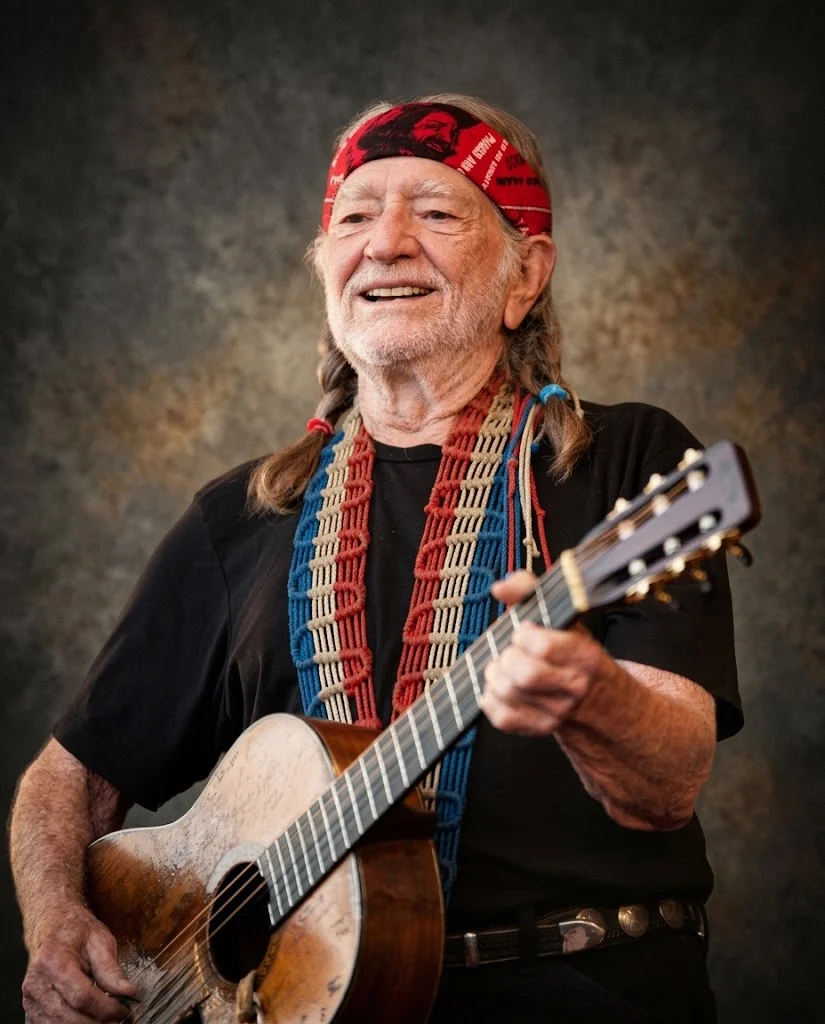
The restrictive suits and turtlenecks of the 1960s were permanently traded for braids, bandanas, and worn-out denim. Standing on a Texas stage with his scarred guitar in hand, Willie finally sang his songs exactly the way he heard them in his head.
The same vocal phrasing that Nashville producers once tried to erase became the defining signature of a multi-platinum American legend. He proved that true country music didn’t require a pristine studio—it only required the truth.
The artist who once could not find a reason to stand up in the snow became the enduring pillar for an entire movement of independent musicians.
The road didn’t end on that frozen asphalt in Tennessee. It simply waited for him to stand up, gather his family, and finally drive himself home.