
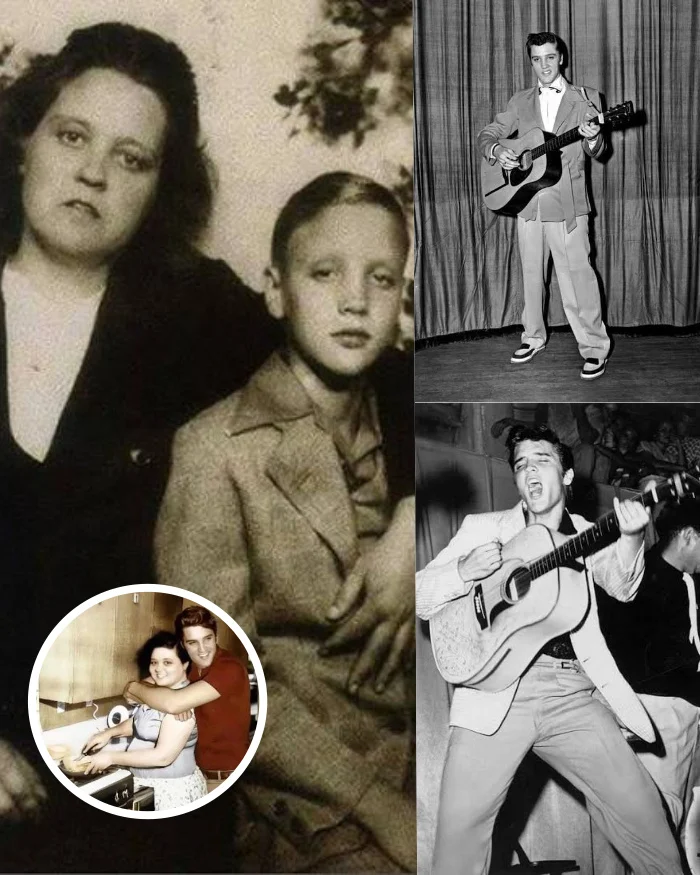
An eighteen year old truck driver paid four dollars to cut a record for his mother, igniting a spark that changed music forever. The boy who would soon redefine American music did not begin with stadiums or commercial ambition. His journey started with a son spending four hard earned dollars just to give his mother a song.
In August 1953, an eighteen year old delivery driver walked through the front door of the Memphis Recording Service at 706 Union Avenue with nearly half a day of wages in his pocket. Fresh out of L.C. Humes High School and earning roughly a dollar an hour hauling wire for the Crown Electric company, Elvis Presley was not looking for an audition or a contract. His family had moved from a small two room shotgun home in Tupelo, Mississippi, into public housing at Lauderdale Courts, scraping by paycheck to paycheck.
The small sum of $3.98 plus tax represented an intentional sacrifice for the quiet young man. He had saved the money to press a two sided acetate demo disc as a personal gift for his mother, Gladys. When studio office manager Marion Keisker greeted him at the front desk, she noted his ducktail haircut and unusually long sideburns, asking him what kind of singer he was and who he sounded like.
Elvis offered a response that stayed with Keisker for years. He told her that he did not sound like nobody. The quiet confidence intrigued her enough that after starting the recording equipment, she jotted a short memo next to his name in the studio records.
Good ballad singer.
Hold.
Alone at the microphone with an inexpensive acoustic guitar, Elvis recorded two sentimental numbers popularized by the Ink Spots, My Happiness and That’s When Your Heartaches Begin. The performance was earnest and slightly nervous, but Keisker secretly ran a separate tape backup and made sure studio founder Sam Phillips eventually heard a tape copy of the session.
When Elvis left the storefront studio clutching the fragile ten inch acetate, he faced a practical hurdle that captured the reality of his family. The Presley apartment did not have a working phonograph. To hear what his voice sounded like pressed into groove, he had to take the disc down the street to the home of his friend Ed Leek, listening to the playback together before carrying it home to his mother.
For nearly a year, nothing happened. Elvis returned to driving his Crown Electric delivery truck around the streets of Memphis, picking up regular shifts while continuing to sing at local church gatherings and family get togethers. The quiet months slipped by without any sign that the Memphis Recording Service session had made an impression beyond the front desk.
The turning point finally arrived in late June 1954, when Sam Phillips came across a demo ballad called Without You and needed an unfamiliar voice to test it. Keisker immediately reminded Phillips of the young driver from Lauderdale Courts who claimed he sounded like nobody. Phillips dialed the Presley residence, inviting Elvis back to Union Avenue to see what he could do with the material.
Though Without You did not pan out in the studio, Phillips recognized something raw and unpolished in the natural phrasing of the teenager. He paired Elvis with local guitarist Scotty Moore and upright bassist Bill Black for an informal evening rehearsal on July 5, 1954. After hours of uninspired ballads, Elvis grabbed his guitar during a break and began wildly picking the rhythm and blues track of Arthur Crudup, That’s All Right, catching Moore, Black, and Phillips completely off guard.
Phillips halted the room, told them to find where to start, and ordered the tape machine to roll. Within days, Memphis disc jockey Dewey Phillips played the track on the Red, Hot, and Blue radio program of WHBQ, prompting dozens of immediate listener phone calls and forcing Elvis into a life he could never have anticipated.
The massive cultural shift that followed would eventually span television broadcasts, historic chart runs, and packed auditoriums across the country. Yet the foundation of that entire journey remained anchored to a hot summer morning in 1953, when a devoted son spent four dollars simply to hand his mother a song.