
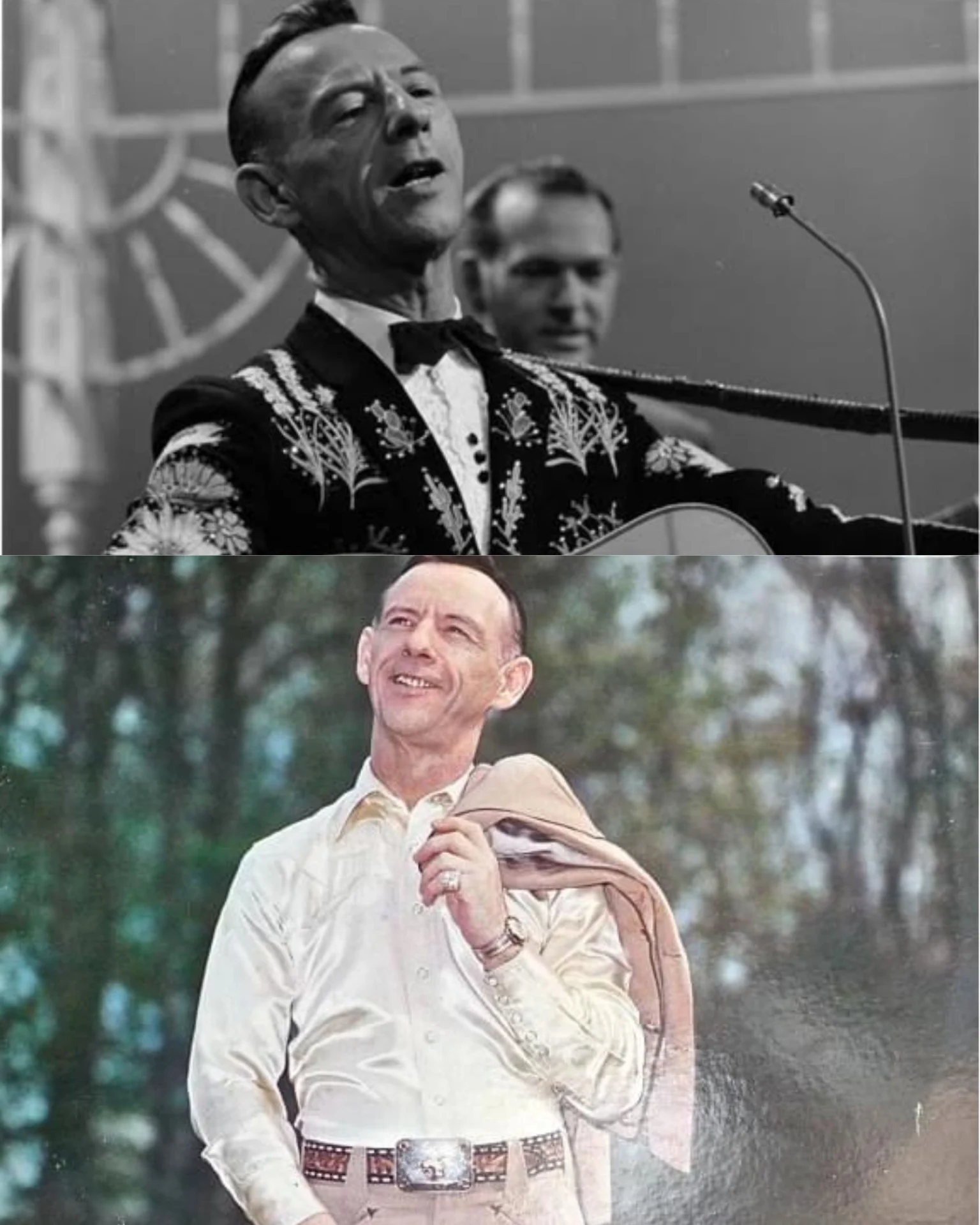
At twelve years old, Hank Snow made a choice that would define the rest of his life. He stepped aboard a fishing schooner off the coast of Nova Scotia, leaving behind an abusive home for the dangerous embrace of the North Atlantic. For decades, the country music legend kept the true reason for his escape buried beneath rhinestone suits and chart-topping hits. But in 1978, at sixty-four, he finally told the world why.
The story begins in 1914, when Clarence Eugene Snow was born near Liverpool, Nova Scotia. His parents sang, his mother played piano, but harmony in the household was fleeting. When his parents separated, eight-year-old Clarence and his sisters were divided. Two girls went to foster homes, while Clarence was sent to live with his paternal grandmother in an arrangement he later described as harsh and emotionally painful. He repeatedly tried to return to his mother, who had remarried, but the reunion brought no safety. His stepfather was violent, and the beatings left lasting scars across the young boy’s body.
“I have never forgotten the abuse I received as a young boy,” Snow wrote years later. “Now it is only natural that I should have a great interest in the welfare of children.”
With only a few years of schooling behind him, Snow saw the harbor as his only way out. At twelve, he signed on as a cabin boy aboard fishing vessels sailing from Lunenburg. The work was brutal—wet decks, heavy gear, cold wind, and voyages that kept him away from land for weeks. But the ships gave him something he had never known at home. Distance. He could earn money and occupy a place determined by work rather than family power.
During quiet hours, Snow sang for the crew and played harmonica. Music entered those voyages as a practical comfort before it became a profession. With money earned around the docks, he purchased a mail-order T. Eaton guitar for $5.95. That inexpensive instrument opened a road leading from Canadian radio to the Grand Ole Opry and “I’m Movin’ On,” the 1950 record that stayed at No. 1 for twenty-one weeks.
Success gave Snow a new name, an audience stretching far beyond Nova Scotia, and a career that spanned forty-seven years with RCA Victor. He became the Singing Ranger, a man famous for leaving towns and broken relationships. But behind that image, he remained unusually disciplined about business, operating publishing interests and owning radio stations. Poverty had taught him what insecurity cost. Fame did not make him casual about money or control.
Nor did it make childhood disappear.
By the 1970s, Americans were becoming more willing to discuss child abuse as a public problem rather than a private family matter. Snow entered that conversation with memories he could authenticate on his own body. He described his stepfather as cruel and recalled punishments severe enough to leave lasting scars. His language was direct, without asking listeners to admire him for surviving.
In 1978, he established the Hank Snow International Foundation for the Prevention of Child Abuse and Neglect. He organized benefit performances, supported foster children internationally, and began telling audiences why the cause belonged to him. The work revealed a side of the Singing Ranger that the traveling songs could not.
“I have never forgotten the abuse I received as a young boy,” he wrote when explaining the foundation. “Now it is only natural that I should have a great interest in the welfare of children.”
Snow used performances to raise awareness and money for prevention. The foundation supported children and foster-care efforts, while his public statements gave the subject visibility among audiences who might never have discussed it otherwise. Contemporary Opry material described the foundation as one of the parts of his life that pleased him most.
In Brooklyn, Nova Scotia, a children’s playground was eventually dedicated on the land where his parents’ home had once stood. The house did not survive. But children laughing on its ground did. Playgrounds are built around an expectation of safety. Adults prepare the space, inspect the equipment, and allow children to move freely within it. The ordinary sound of play depends upon somebody having done that work.
For Snow, whose early years contained so little dependable protection, the use of that land offered no correction to history. It could not reunite the divided children or return a twelve-year-old from the schooner. But it gave the ground another duty.
Hank Snow recorded more than one hundred albums and carried country music to audiences around the world. He remained at the Grand Ole Opry into old age, dressed with precision and sang with the restraint that had distinguished him for decades. The child-abuse foundation never produced a record as famous as “I’m Movin’ On.” Its achievement belonged to a quieter measure.
Snow had grown up during a period when children could be scattered, beaten, or driven from school without many adults naming what had happened to them. His success could have allowed him to seal that history away. Instead, he placed it in public view and connected his most painful memories to children whose names he would never know.
Near Liverpool, visitors can trace the route from the harbor to the places where Snow’s early life unfolded. The schooners are gone. The cheap guitar became an artifact of biography. The songs continue traveling without him. On the former family ground, the motion is smaller. A child climbs, runs, and returns safely to earth.