
In August 1975, Hank Williams Jr. plummeted nearly 500 feet down Ajax Mountain in Montana—and the fall shattered more than his face. It broke the mold that had trapped him for decades, ultimately setting him free.
For a man who had spent his entire life on stage, the accident could have ended everything. Instead, it gave him the courage to finally become himself.
The injuries were catastrophic. Severe skull trauma, multiple facial fractures, and a grueling series of reconstructive surgeries left him physically broken. But the deeper damage was psychological. Since age eight, he had been pushed into the spotlight by his mother, Audrey, told to wear tailored suits and mimic his late father’s iconic voice.
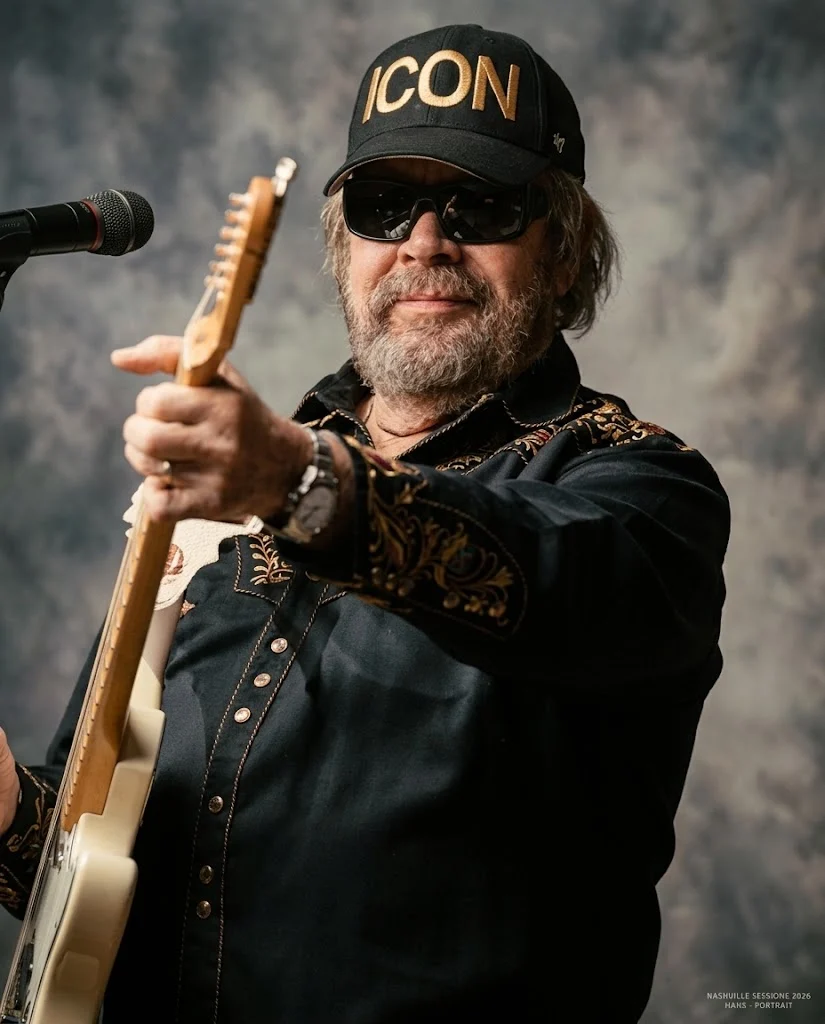
As the surgeries dragged on, he made a radical decision. He grew a thick beard and wore dark sunglasses to hide the scars—but the look became something far more powerful. It was the birth of the Outlaw image.
Walking away from the polished “Nashville Sound” that had controlled his early career, he relocated to Cullman, Alabama. Still recovering, he stepped into the studio with a new perspective. Collaborating with Southern rock and Outlaw pioneers like Waylon Jennings, he began blending traditional country with gritty, unpolished rock and blues.
Those early recording sessions were a testing ground. Free from executive oversight, he broke the rules. The result was a sound that was raw, honest, and entirely his own.
By 1979, that quiet rebellion exploded onto the charts. Whiskey Bent and Hellbound and Family Tradition turned his personal struggles, flaws, and wild lifestyle into massive autobiographical hits. The title track of Family Tradition became a defiant statement: he did not reject his legendary bloodline—he claimed the right to inherit the rebellion, not just the voice.
The reinvention paid off. Throughout the 1980s, he dominated the charts and won multiple CMA Entertainer of the Year awards. Country audiences craved raw honesty over packaged nostalgia.
Today, the beard and sunglasses are recognized globally as the uniform of an Outlaw icon. They are no longer just hiding scars—they are the armor of a man who survived a literal freefall to finally own his name.