
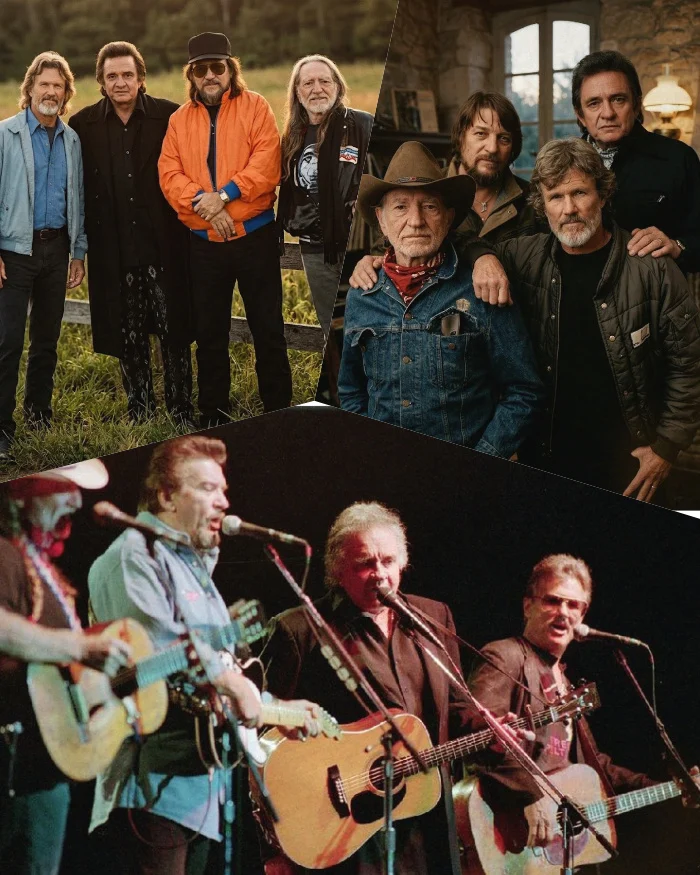
In October 1994, four legends of country music gathered in a Los Angeles studio for what would become their last album together. Producer Don Was made a bold decision: instead of isolating the singers in separate booths, he placed Johnny Cash, Waylon Jennings, Willie Nelson, and Kris Kristofferson in a circle facing each other.
The setting was Ocean Way Recording on Sunset Boulevard, a far cry from their first collaboration a decade earlier. In 1984, the quartet had formed during a television special in Montreux, Switzerland, before releasing their platinum-selling debut album “Highwayman” in 1985. Those early projects, produced by Chips Moman, featured grand arrangements and the powerful voices of four country titans at their commercial peak.
By 1994, however, the physical realities of decades on the road had taken their toll. Cash, at 62, battled diabetes, heart complications, and early symptoms of autonomic neuropathy. Jennings, 57, had undergone triple bypass surgery in 1988 and was managing severe diabetes and vascular issues that made long days exhausting.
Was, known for his work with Bonnie Raitt and Nelson, convinced Liberty Records executives to record in Los Angeles rather than Nashville. He assembled a tight studio band including Benmont Tench, Marty Stuart, Mickey Raphael, and Reggie Young. The goal was simple: capture all four singers live, together, in the same room.
The circular setup transformed their creative process. Sitting within arm’s reach, the four men could read each other’s every breath and subtle nod. When Cash’s deep baritone grew raspy or Jennings needed extra rest between takes, Nelson and Kristofferson stayed in their seats, trading dry road stories until their friends were ready to continue.
Kristofferson, then 58, still carried the habits of the former Army captain who had swept floors at Columbia Recording Studios in Nashville in the mid-1960s just to pitch songs to Cash. Throughout the sessions, he deferred to his bandmates during playback discussions, visibly moved whenever Cash or Nelson locked into a verse beside him.
Rather than writing new material on a tight schedule, the group selected eleven songs that matched their weathered voices. They opened with Steve Earle’s “The Devil’s Right Hand” and took on Robert Earl Keen’s narrative ballad “The Road Goes On Forever,” trading verses the way they had on Jimmy Webb’s “Highwayman” nine years earlier.
The emotional heart of the sessions emerged in two songs by Texas writers. On Stephen Bruton’s “It Is What It Is,” Nelson’s nylon-string guitar Trigger wove around four voices accepting the passage of time without complaint. To close the album, they recorded “Live Forever,” written by Billy Joe Shaver and his son Eddy. In the studio, the three others softened their delivery to frame each solo line, steadying the tempo whenever Cash or Jennings stepped up to the microphone.
The quartet also reached into their own notebooks. Cash contributed the reflective ballad “Death and Hell,” while Jennings brought “I Do Believe,” giving each member a moment to speak in his own words before the album wrapped.
Liberty Records released “The Road Goes On Forever” on April 4, 1995, accompanied by a brief concert tour across the United States and Japan that spring. Although commercial country radio had largely moved on to a younger generation of hat acts, the record stood as the final studio document of the four friends together.
Seven years after those days in Los Angeles, Jennings died of diabetes complications in February 2002 at age 64, and Cash died in September 2003 at age 71. What remained from the autumn of 1994 was the sound of four chairs pulled close in a Hollywood studio, where four old friends matched their breathing so no one had to sing alone.