
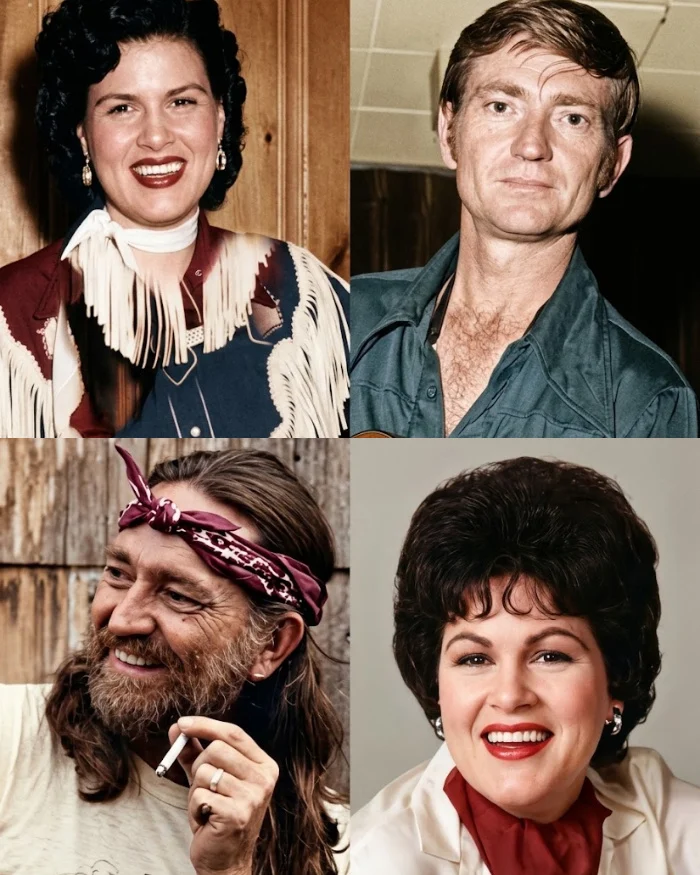
On a sweltering August evening in 1961, Patsy Cline hobbled into Nashville’s famed Quonset Hut studio on crutches, her body still mending from a near-fatal car crash. She was about to attempt the most challenging vocal of her career—but after four hours, she left without a single note on tape. The song was ‘Crazy,’ written by an unknown Texas songwriter named Willie Nelson, and its journey to becoming a country standard is a story of pain, perseverance, and serendipity.
Just two months earlier, on June 14, 1961, Cline and her brother were driving home when a head-on collision on Old Hickory Boulevard shattered her world. The impact left the 28-year-old with a broken hip, a dislocated wrist, bruised ribs that made every breath a battle, and a scar across her forehead. While she recovered at Madison Hospital and later at home, a young Willie Nelson was struggling to survive in Nashville. His Texas home had burned down, forcing him to pile his belongings into a beat-up 1950 Buick and drive east. He spent his nights at Tootsie’s Orchid Lounge, selling song rights for 50 dollars just to pay rent.
Nelson had originally written the ballad—initially called ‘Stupid’—with country singer Billy Walker in mind. But when Walker turned it down, calling it a woman’s song, Hank Cochran brought the demo to Cline’s producer, Owen Bradley. Around the same time, Cline’s husband, Charlie Dick, heard the rough track spinning on Tootsie’s jukebox and insisted his wife hear it. Late one night, Dick brought Nelson to their home, waking Cline from bed to play the reel-to-reel tape in the living room.
Cline was hesitant at first. Nelson’s demo featured a halting, behind-the-beat conversational delivery that clashed with her rich contralto. But with Bradley and Dick’s encouragement, she agreed to make ‘Crazy’ her first recording project after the hospital. On August 16, she arrived at the Quonset Hut with Nashville’s finest session musicians: pianist Floyd Cramer, guitarist Hank Garland, bassist Bob Moore, drummer Buddy Harman, and the Jordanaires on backing vocals.
Because standing was agonizing on her healing hip, Cline leaned against a stool. But every time she reached for the high opening note, her bruised ribs tightened, cutting off her breath. Worse, she kept trying to mimic Nelson’s jazz phrasing, which threw off her natural style. After hours of struggle, she was physically and emotionally spent. Bradley sent her home to rest, and the band recorded the instrumental backing with the Jordanaires singing to an empty microphone.
For three weeks, Cline listened to that backing tape at home, her ribs slowly healing, and she worked out how to make the melody her own.
When she returned in early September, she stepped up to the microphone, set Nelson’s timing aside, and sang in her own sweeping style. She nailed the entire lead vocal in a single take.
Released on October 16, 1961, ‘Crazy’ soared to Number 2 on the Billboard Hot Country Singles chart and crossed over to Number 9 on the Hot 100, becoming the biggest pop hit of Cline’s life. For Nelson, the royalties finally lifted him out of the lean years of selling songs for pocket cash. The crutches were long gone by the time the record reached radio, and the vocal Patsy Cline finished in one take turned a 50-dollar midnight demo into a timeless standard that outlived them both.