
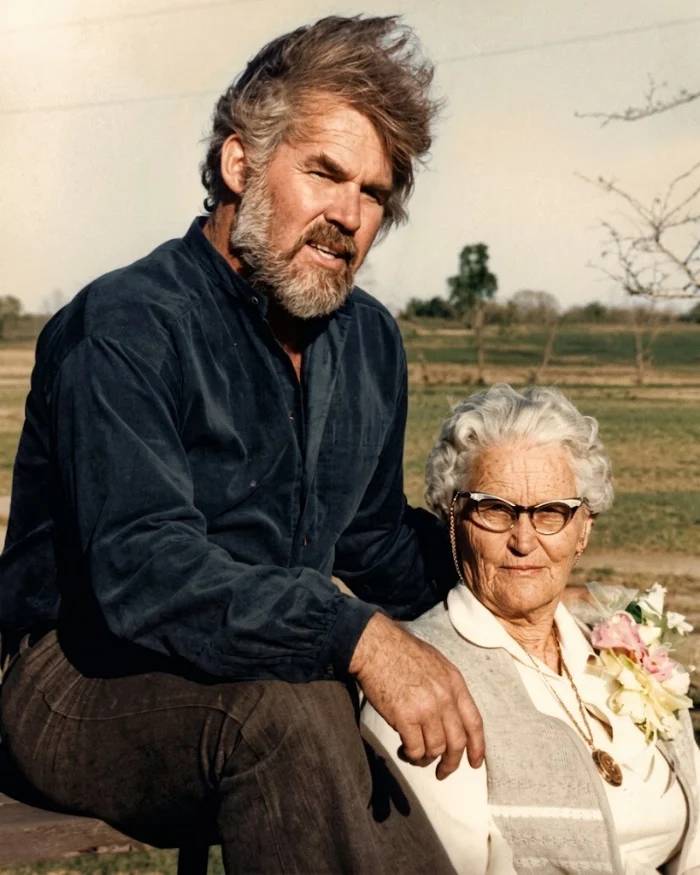
She came through the door with swollen feet at dawn, eased herself onto the edge of a bed, and closed her eyes for a few hours before the apartment filled with voices again. That was Kenny Rogers’ first memory of strength. That was Lucille.
Before the arenas and the platinum albums, before the name on the marquee, there was a nursing assistant in San Felipe Courts who refused to let poverty tell her children who they were. The same hands that scrubbed floors and ironed other people’s laundry also held a young boy together when everything around him swayed.
Kenny Rogers was born on August 21, 1938, at St. Joseph’s Hospital in Houston. His first home was an East End rooming house without electricity, with an outhouse standing in the yard. Soon after, Edward Floyd Rogers and Lucille Lois Hester moved their growing family into a sprawling brick public housing development known as San Felipe Courts, built west of downtown near Buffalo Bayou. Kenny was the fourth of eight children, and the Texas heat sat heavy in unairconditioned rooms.
His father was a carpenter with a skilled hand, but alcohol drained the household money and made the small apartment unsteady. Lucille carried the family through work. She labored as a janitor, took shifts at restaurants, and ironed mounds of laundry for other people. Then she took overnight work as a nursing assistant at a local hospital and walked home at daybreak with her feet swollen.
She rested only a little. Then she rose to dress eight children and lead them to the local Baptist church.
‘The adult you become will never rise above the moral foundation planted in you as a child,’ she told Kenny when he complained about the constant services.
Sunday morning, Sunday night, and Wednesday evening were non-negotiable. The pews became a stable center for a boy whose home life sometimes tilted. Outside the apartment, the streets around the Fourth Ward offered trouble. Lucille answered that pull with a rule that hardship could not become an excuse. She never complained about bills in front of her children. She reminded Kenny that an empty pocket was temporary and had nothing to do with character.
Music slipped into that ordered world during Kenny’s years at Jefferson Davis High School. He played with his high school band the Scholars at local sock hops and neighborhood dances. Even when weekend gigs ran late, Lucille’s rules did not bend.
In the spring of 1956, at age seventeen, Kenny Rogers walked across the graduation stage as the first person in his extended family to earn a diploma. That fall he enrolled briefly at the University of Houston. In 1957 he recorded his early solo single ‘That Crazy Feeling’ for the local Carlton label and appeared on Dick Clark’s American Bandstand.
From there his career moved through jazz with the Bobby Doyle Three, folk-pop with the New Christy Minstrels and the First Edition, and finally solo country stardom in the late 1970s. Lucille was watching the entire time. She delivered one more warning before his name got big.
‘Treat people well on the way up,’ she said, ‘because you will meet the same people on the way back down.’
Kenny took that message onto the largest tours in American music. In the 1980s, while arenas filled every night and albums sold by the tens of millions, he learned crew members’ names. He spoke plainly to stagehands. He gave the same respect to catering workers and sound technicians as he gave to record executives.
Once the money came, he made sure Lucille never needed to work another hospital shift or worry about housing again. She lived to watch her son become a worldwide star, and she held him to the same plainspoken manners until her passing in 1991.
More than twenty years later, Kenny Rogers sat down to write his 2012 memoir, Luck or Something Like It. In it, he traced his survival in a volatile business straight back to Houston. Before the tour buses and the platinum plaques, there was a mother in San Felipe Courts waking up after a night shift to iron church clothes for eight children. That is the foundation no stage can outshine.