
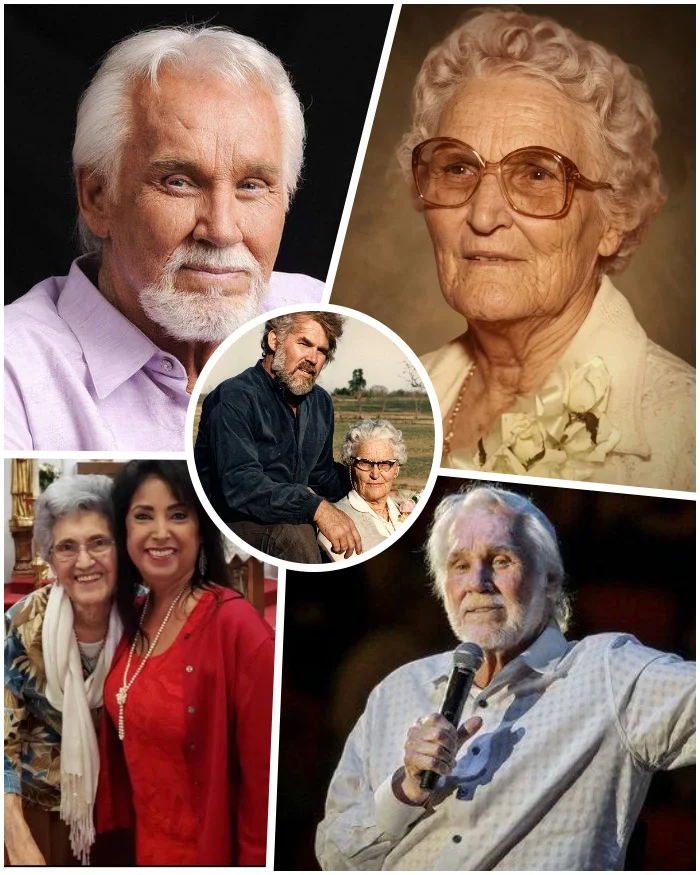
Before the Grammy Awards, before the 120 million records sold, before the Country Music Hall of Fame, there was a cramped apartment in Houston’s San Felipe Courts federal housing project. And there was Lucille Lois Rogers, a nursing assistant with wisdom that would echo through her son’s entire life.
Kenny Rogers, the fourth of eight children, didn’t know his family was poor in the 1940s and ’50s. Everyone in the housing project lived the same way. His father, Edward Floyd Rogers, worked as a carpenter but his heavy drinking drained the household finances. It was Lucille who held everything together on her small wages and extra cleaning shifts.
The realization hit Rogers in his teens, when he wandered beyond the project and saw Houston’s wealthier neighborhoods. “Resentment began to build as he compared those manicured streets to his own crowded home,” and the urge to escape grew fierce. Seeing this, Lucille took her son’s hand and gave him two sentences that would guide him for the next sixty years.
“Son, be happy where you are, but never be satisfied to stay there. Because if you can’t be happy where you are, you’ll never be happy anywhere.”
Those words dissolved the boy’s quiet shame without letting it harden into bitterness. He stayed at Jefferson Davis High School and became the first in his extended family to graduate, walking across the stage in 1956. He saved his busboy wages from the Rice Hotel to buy his first guitar, and by 1958 he recorded “That Crazy Feeling” under the name Kenneth Rogers.
When that early teen-idol momentum faded, Rogers didn’t quit. He played stand-up bass with the Bobby Doyle Three in Houston jazz clubs for years, taking the unglamorous role because, as a local pianist pointed out, a working bass player could always find a gig.
That willingness to keep moving carried him through the next decade. In 1966, he joined the New Christy Minstrels as a backup singer, then broke away in 1967 to form the First Edition. The band gave him national hits, but by the mid-1970s, the 37-year-old found himself in Nashville with roughly $60,000 in debt and starting over in a different genre.
Signing with United Artists Records and teaming with producer Larry Butler, he rebuilt his career as a solo country storyteller. Ironically, the 1977 breakthrough ballad that cleared his debts and earned his first Grammy was titled “Lucille.” When his mother heard the song about a woman walking out on her family, she called and scolded him, assuming he’d named it after her.
As his fame grew into more than 120 million album sales worldwide, a 2013 Hall of Fame induction, and ventures in photography and restaurants, Lucille kept him grounded. She joked that the boy had never worked a day in his life because all he ever did was sing. Even in her seventies, she climbed a neighbor’s fence in a bright orange jumpsuit to fish in a private lake.
Lucille died in 1991, more than two decades before Rogers sat down with AARP and The Diane Rehm Show in October 2012 to discuss his memoir, Luck or Something Like It. At 74, with knee surgery behind him and young twin boys at home, he noted that his early drive for success had once cost him time with his family. Word for word, he still repeated his mother’s two sentences, carrying her voice all the way to the close of his own life in March 2020.
Long after the nine-dollar hat store shifts and the sold-out arenas had both passed into history, the millionaire singer sitting in a broadcast studio was still answering to the nursing assistant who took his hand in San Felipe Courts.