
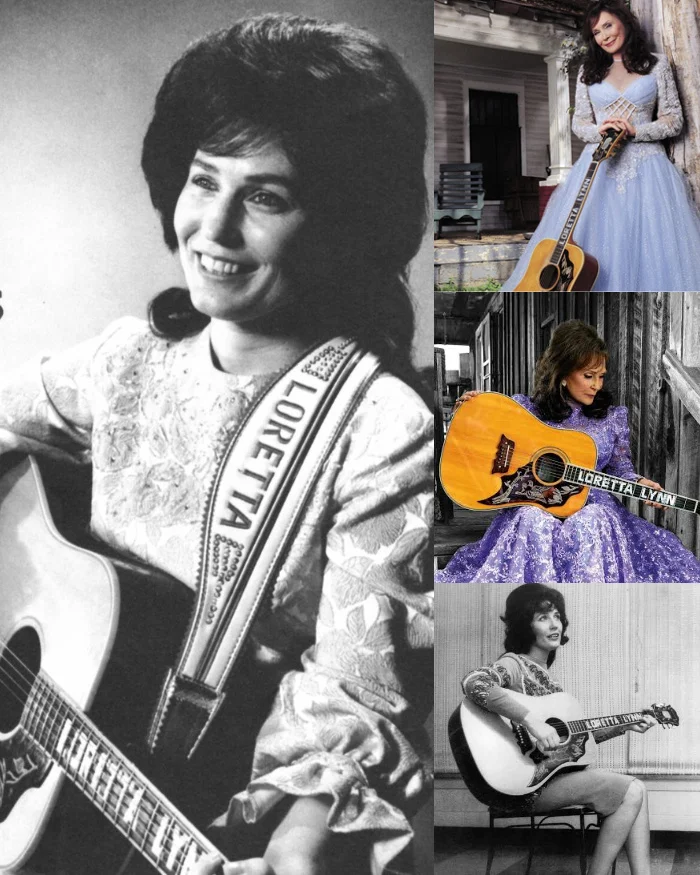
In the autumn of 1969, a 37-year-old woman with a voice like gravel and a heart full of memories stepped into a barn in Mount Juliet, Tennessee, carrying nine verses that would change country music forever. Loretta Lynn wasn’t there to perform a polished ballad or a radio-friendly heartbreak tune. She was there to deliver a eulogy for a childhood the industry had never dared to sing about—a life of freezing nights, Sears Roebuck pages stuffed into walls, and a father who came home every day blackened by coal dust.
Bradley’s Barn, a converted farm building built by producer Owen Bradley, was an unlikely cathedral for such a confession. It sat far from the neon glare of Music Row, offering a quiet, rural intimacy that allowed Lynn to strip away every pretense. Her original draft was sprawling—a hyper-specific, unvarnished documentary of poverty in Butcher Holler, Kentucky. She wrote about a mother whose fingers bled from washboards, about the mine that swallowed her father’s strength, about the sheer exhaustion of a family surviving the Great Depression. It was not a song; it was a testimony.
Owen Bradley, a legend in his own right, knew he was hearing something sacred. But he also knew the unforgiving clock of country radio. Songs that stretched past three minutes were often ignored. So he sat with Lynn and, with a gentle but firm hand, encouraged her to trim the story down. She sacrificed verses, condensing a lifetime into a tighter, sharper narrative that still carried the raw, visceral weight of the original.
When the red light flickered on, Bradley made a bold choice. He refused to bury her voice under strings or choruses. Instead, he built the track around a rolling banjo and a simple rhythm section, leaving her vocals completely exposed. Lynn didn’t soften her mountain dialect or smooth her edges. She sang with a conversational grit that made listeners feel like they were sitting at her kitchen table, hearing a truth that had never been spoken aloud in a studio before.
That single take became “Coal Miner’s Daughter.” By late 1970, it had climbed to No. 1 on the Billboard Hot Country Singles chart, proving that unflinching autobiography could sell just as many records as any love song. The song became an anchor—first as a 1976 bestselling memoir, then as the 1980 Oscar-winning film starring Sissy Spacek. For five decades, it was the track she had to sing at every show, a living reminder of where she came from.
But the true weight of that October afternoon was never about chart positions or Hollywood gold. Loretta Lynn walked into a barn with a notebook and walked out with a legacy. She took the invisible, exhausted lives of Butcher Holler families and gave them a permanent voice in American history. She didn’t just sing about coal dust—she turned it into a crown.