
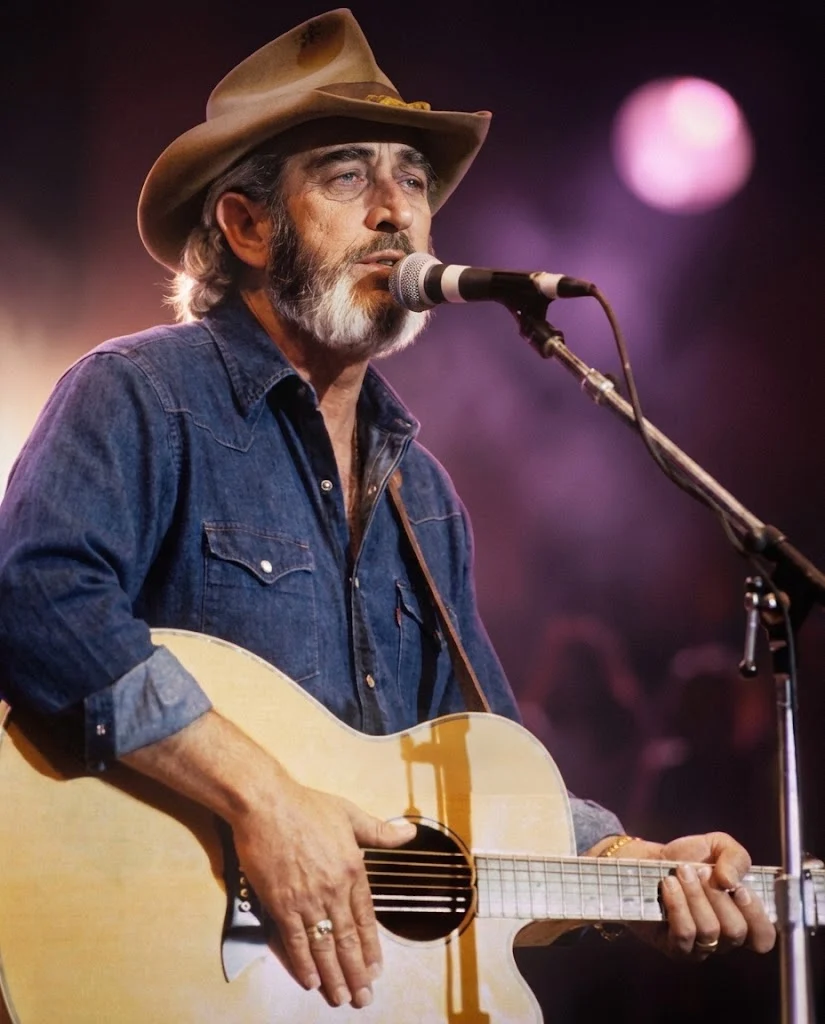
When Don Williams announced his retirement in March 2016, the country music world paused—not because of a grand spectacle, but because of a single, understated sentence. The “Gentle Giant” didn’t book a stadium tour or chase a final roar of applause. Instead, he simply said it was time to “hang my hat up.” For a man who spent 50 years building a legacy on a rumbling baritone and quiet dignity, that was the perfect exit.
Williams had never been one for flash. While Nashville embraced pop-crossover theatrics in the ’80s and ’90s, he stuck to what he knew: honest songs like “Tulsa Time”, “I Believe in You”, and “Good Ole Boys Like Me”—tracks that felt like a conversation across a kitchen table. He accumulated 17 Billboard Country No. 1 hits and a Country Music Hall of Fame induction in 2010, yet he treated global fame with the same humility as a local gig.
His stage was famously stripped down: just a wooden stool, a worn guitar, a cup of coffee, and that signature Stetson. The hat was never a costume—it was a symbol of his unwavering presence in a genre that kept shifting. When he said he was hanging it up, fans didn’t mourn; they pictured a cowboy stepping into a cabin, setting his hat on a peg, and knowing the work was done.
Williams walked away to protect the life he’d always sung about. He retreated to his farm in Ashland City, Tennessee, where he gave his time to Joy, his wife of nearly six decades. The 18 months after retirement were fiercely guarded by his family, who shielded him from the industry’s demands as he privately battled emphysema. No interviews, no cameras, no final collaborations—just peace.
“He spent his final days sitting quietly, breathing the Tennessee air, surrounded by his children and the woman who had been with him since before the world knew his name.”
When he passed on September 8, 2017, at 78, the news came only after he was already gone. The family had protected his dignity to the very last breath, ensuring his departure was as peaceful as his melodies. The music world mourned, but there was no tragedy—he had finished his work and made it home before sundown.
The stage he left behind is empty, but for a man whose greatest gift was quiet steadiness, the silence still sounds exactly like him.