
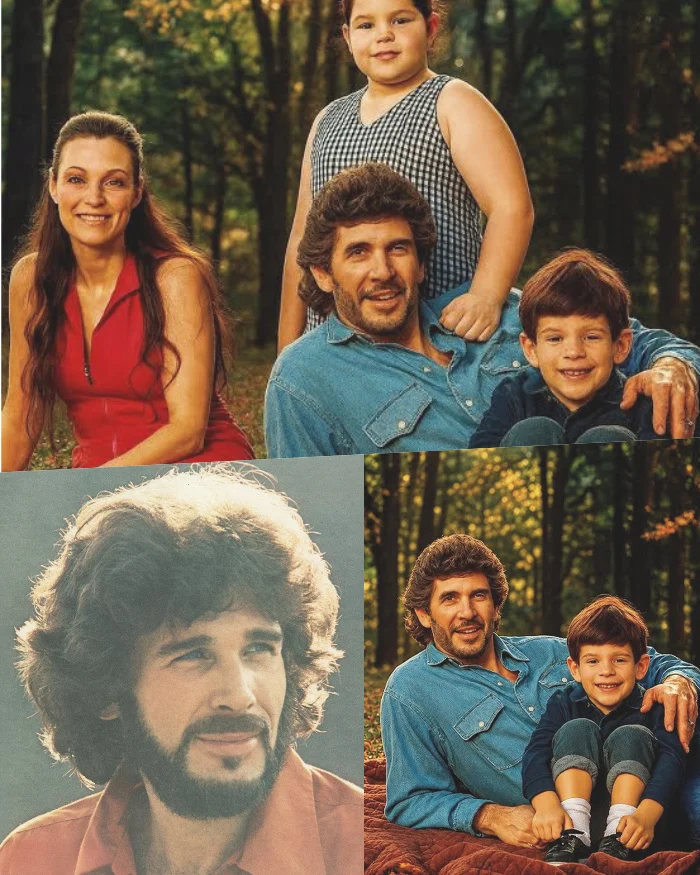
The silence in Eddie Rabbitt’s Nashville home was finally broken by the most beautiful sound imaginable—the healthy cry of a newborn baby boy. After the devastating loss of their toddler son Timmy to liver disease in 1985, Rabbitt and his wife Janine Girardi welcomed Tommy in 1986, a moment that healed wounds no medicine could reach. For years, grief had hung over their household like a heavy fog, but cradling his son, Rabbitt found himself looking down without the shadow of hospital corridors or the dread of medical monitors. Janine, holding Tommy close, felt the maternal ache she’d carried for years begin to mend.
Their daughter Demelza embraced her little brother with pure joy, and the once-somber rooms filled with laughter and childish energy again. That emotional transformation didn’t just heal the family—it reignited Rabbitt’s creative fire. When he walked into a Nashville recording studio in autumn 1987, he wasn’t the same man chasing pop-radio glory. He was a father reborn, carrying a relaxed confidence that had been missing since the early 1980s.
Working with producer Richard Landis, Rabbitt traded arena-rock ambitions for rhythmic, upbeat melodies that let his warm baritone lead the way. The turning point came with his 1988 RCA album I Wanna Dance with You. The title track, co-written with Even Stevens and Billy Joe Walker Jr., wrapped a sunny acoustic groove around bright vocal harmonies. Radio programmers couldn’t resist its buoyant energy, and by April 1988, it climbed to Number 1 on Billboard’s Hot Country Singles chart.
But Rabbitt wasn’t done. He reached back to his rock-and-roll roots, cutting a driving country-rock version of Dion’s 1961 classic “The Wanderer.” With a punchy backbeat and crisp acoustic guitar, his rendition shot to the top of the charts in August 1988—his second consecutive Number 1 from the same album. It proved he was one of the few 1970s hitmakers who could dominate the late-1980s radio landscape.
“The chart resurgence opened doors to lucrative touring offers, but Rabbitt set strict boundaries. He refused grueling months-long itineraries, limiting concerts to compact weekend runs so he could be home for school drop-offs and dinners with Janine, Demelza, and little Tommy.”
In 1990, Rabbitt moved to Capitol Records and released Jersey Boy, a love letter to his Newark roots. The single “On Second Thought” soared to Number 1, marking his seventeenth chart-topping country hit and placing him among an elite group of artists whose success spanned three decades.
Eddie Rabbitt’s late-1980s comeback wasn’t about chasing trends—it was about finding himself again. Behind every infectious acoustic hook and chart-topping single stood a man who had rediscovered his grounding where it mattered most: at home, where the laughter of his growing family had replaced the quiet echoes of loss. His greatest musical revival didn’t begin under stage lights; it started in a nursery, where his family learned to breathe again.