
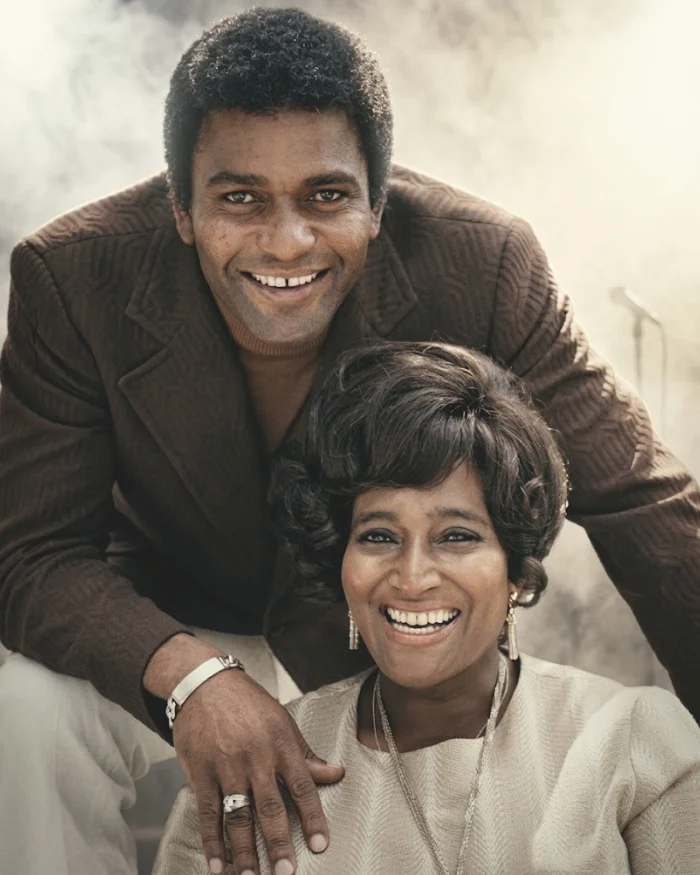
History remembers the pioneer who broke the color barrier in Nashville. But the real breakthrough happened years earlier, in a Memphis church, when a young woman said yes to a man with nothing but a fading dream.
In late 1956, Charley Pride stood at a crossroads. A talented Negro League ballplayer with a minor-league paycheck and a future as uncertain as the Montana skies he would soon call home, he asked Rozene Cohran to marry him. Her family and friends urged her to walk away. They saw a struggling athlete with no financial security)Skip. Rozene saw something else.
She saw a man of grounded character, and she heard the stunning power of his deep baritone voice long before a microphone ever captured it. On December 28, 1956, while Charley was on a brief leave from Army basic training, they married—ignoring every warning, betting everything on a shared future.
The early years were brutal. Charley’s baseball dreams kept them moving, eventually relocating to East Helena, Montana, where he took a dangerous job at the American Smelting and Refining Company. He worked grueling factory shifts and played semi-pro ball on the side, while Rozene managed the stark reality of their daily life—navigating harsh Northern winters, stretching meager wages, and raising three children: Kraig, Dion, and Angela.
To earn extra money, Charley began singing. His deep baritone voice echoed over stadium PA systems before games, and soon he was driving up to eighty miles after his factory shifts to perform in taverns in Anaconda and Great Falls—playing for tips before driving back in the dark to report for work at the smelter.
But the baseball dream was dying. An aggressive spring training tryout with the California Angels resulted in a severe arm injury, and the realization set in: a major-league contract was never coming. For a lifelong athlete, that collapse of identity was devastating.
Yet Rozene did not complain about the poverty or the years spent in a smelter town. She anchored him. She protected his fractured confidence and encouraged him to redirect his focus toward the music he had been sharing in Montana bars. Because she carried the immense weight of their household, Charley had the freedom to pivot entirely to country music.
When national acts like Red Sovine passed through Montana, Charley secured opportunities to perform for them, eventually earning an invitation to audition in Nashville. When he signed with RCA Records and broke the genre’s color barrier in the mid-1960s, the Nashville establishment saw a sudden, unprecedented phenomenon. Rozene saw the direct result of their quiet endurance in East Helena.
As Charley became country music’s first Black superstar, Rozene remained the unshakeable center of his world. She managed the complex business logistics of his booming career)Skip. When touring across a deeply divided nation brought intense racial prejudice and pressure, she protected their private sanctuary in Dallas, shielding their children from the industry’s hostilities.
Their partnership lasted exactly sixty-four years, ending only when Charley passed away in December 2020 at the age of eighty-six.
The history books credit Charley Pride with the rare courage to integrate the Nashville charts. But his transition from the smelting plant to the Country Music Hall of Fame was never a solo achievement. Before the millions of records were sold, a young woman in Memphis looked at a struggling minor-league ballplayer, signed a marriage license, and gave him the steady ground he needed to find his true voice.
That was the greatest leap of faith in his career. It didn’t happen in a recording studio. It happened when Rozene said yes.