
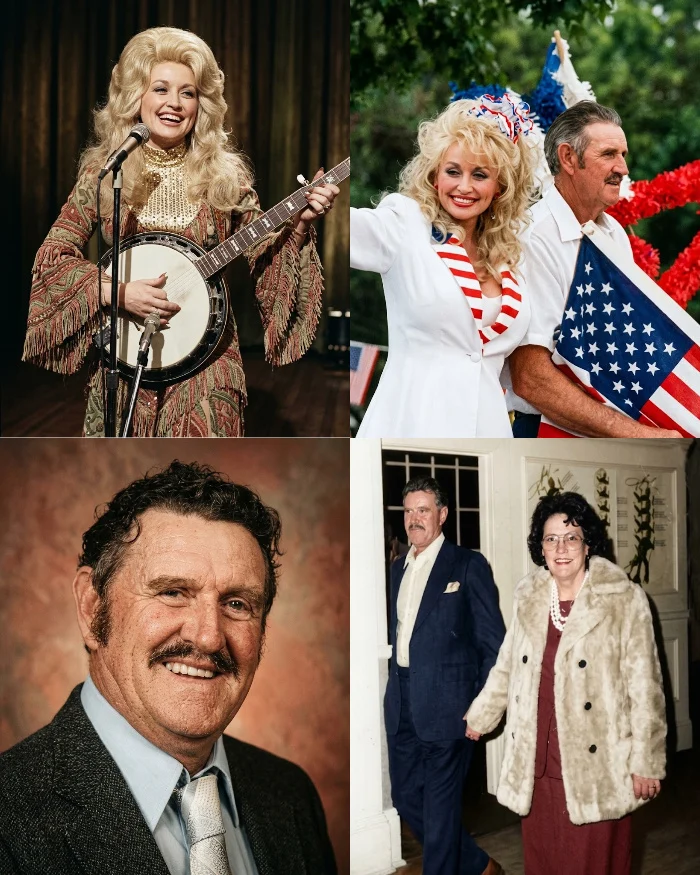
When the most powerful manager in music demanded half the publishing rights to her biggest song, Dolly Parton walked away. She cried over the choice, but she trusted a financial compass forged by a Tennessee sharecropper who never learned to read, and that instinct protected her career.
In 1974, Elvis Presley wanted to record I Will Always Love You. It was a dream scenario for any songwriter, yet it came with a strict ultimatum from his manager Colonel Tom Parker. Presley would require a fifty percent surrender of the publishing rights before he stepped up to the microphone. For an emerging artist, saying no to the King of Rock and Roll seemed like an impossible risk. Parton held her ground and kept her copyright.
That refusal did not come from a formal business degree or from advice given by corporate attorneys. It came directly from the survival instinct she absorbed from her father Robert Lee Parton.
He raised twelve children in the extreme poverty of the Great Smoky Mountains, where keeping a family alive on steep and unforgiving terrain required a strict understanding of what labor was actually worth. In Locust Ridge, money was scarce and carried a physical weight in the Parton household. Every cent mattered when a few coins decided whether the family had cornmeal for the week or went to bed hungry. Robert Lee had been forced to leave school as a young boy to work the fields, but his grasp of bargaining, crop yields, and risk assessment was flawless.
Giving away the rights to her own words was no different than letting someone else claim the harvest from a field she had plowed herself.
As Parton navigated the notoriously predatory Nashville music industry of the 1960s and 1970s, she applied her father’s mountain logic to record contracts and tour negotiations. While many artists of her era signed away their master recordings and publishing rights for quick cash, Parton retained absolute ownership of her catalog.
Even after she built a multimillion dollar entertainment empire, her father’s relationship with money and his view of her wealth remained entirely unchanged. He refused to let her massive tax bracket alter his fundamental pride. If Parton asked him to run a simple errand or buy supplies in town, he returned to her with every single penny of the leftover cash.
Robert Lee carefully smoothed out the wrinkled bills and counted the loose coins into her hand with his calloused and weather beaten fingers. He always insisted she double check the amount to ensure no local merchant had shortchanged them. To the rest of the world, his daughter was an international icon with seemingly limitless resources. To him, she was still a daughter who needed to be reminded to protect what she had worked for.
That grounded philosophy heavily influenced her largest career investments. When she expanded her brand beyond music, she did not place her money into abstract Hollywood ventures. In 1986 she invested right back into Sevier County by partnering to create Dollywood. It was a calculated business move that generated thousands of local jobs and turned her wealth into tangible land and community infrastructure, something a mountain farmer inherently trusted.
Countless musicians have generated millions in revenue only to lose it through bad deals, predatory management, or reckless spending. Parton preserved and multiplied her fortune because she never lost the perspective of the man who raised her. She famously called him the smartest man she ever knew and recognized that his intelligence was built on navigating reality rather than reading textbooks.
The woman who wrote thousands of songs kept her empire intact because she understood exactly who she was dealing with at the negotiating table. When the industry tried to take a percentage of her work, they were not just bargaining with a country singer. They were trying to shortchange a sharecropper’s daughter who knew exactly what every single coin was worth.