
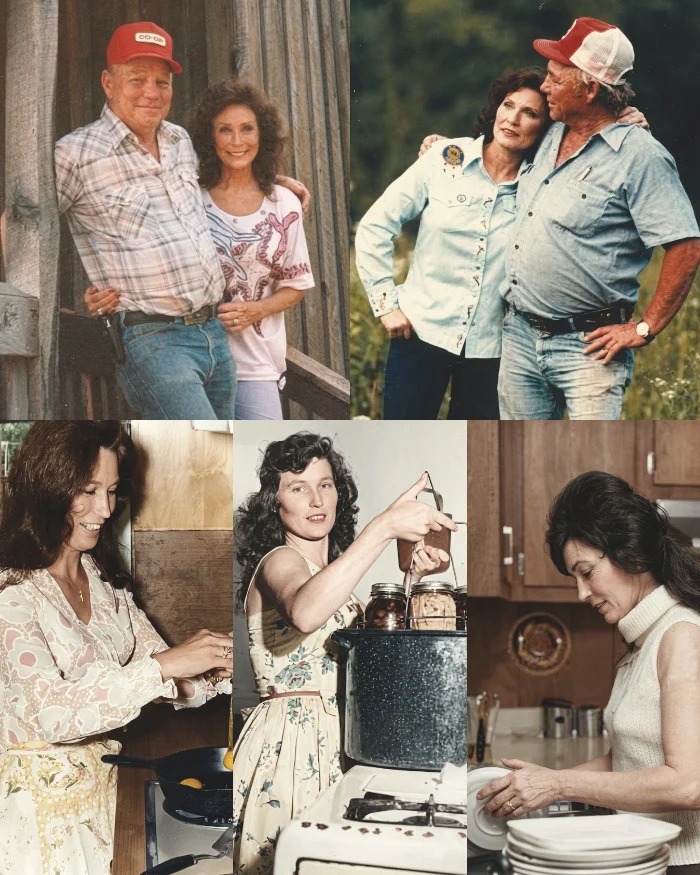
The foundation of her unprecedented catalog was not built inside a pristine Nashville recording booth. It was forged years earlier at a cramped kitchen table, by a husband who recognized the brilliance in the daily struggle of his wife and simply handed her a pen.
Stop scrubbing the floors, sit down, and write out exactly what she was singing.
When twenty seven year old Loretta Lynn sat down at a kitchen table in Washington state with a pen and a blank sheet of paper, she was simply following the instructions of her husband.
For years, the exhausted mother of four had quietly hummed her own melodies to the rhythm of a washboard and a broom. She considered the singing to be nothing more than idle time passing, but her husband Doolittle heard something rare. He issued a firm directive to stop scrubbing the floors and sit down and write out exactly what she was singing.
To help her put melodies to the lyrics she was suddenly drafting, Doolittle scraped together seventeen dollars to buy her a stiff and cheap Harmony acoustic guitar. Night after night, she pressed her calloused fingers into the steel strings until they bled, slowly learning to form chords while documenting the grueling reality of her daily life.
The very first songs she put to paper ignored the polished romantic tropes popular on the radio. She wrote her first completed song Whispering Sea while sitting on a beach. Her second song I Am a Honky Tonk Girl was drafted after she spent a day picking strawberries and noticed a local woman crying over a broken marriage in a nearby tavern.
Those raw and handwritten lyrics quickly grew too big for the family kitchen. In early 1960, a tiny label called Zero Records financed her first recording session. Bringing that music to a national audience required a massive gamble. The couple mailed out thousands of copies of the single to radio stations, then spent three months sleeping in their 1955 Ford on a relentless cross country promotional tour.
Their self made momentum pushed I Am a Honky Tonk Girl onto the Billboard Country chart, forcing the industry to pay attention. But arriving in Nashville later that year marked an intimidating transition for a woman with no formal industry connections.
The Nashville establishment of the early 1960s was heavily male dominated, and female vocalists were rarely encouraged to write their own material. Most singers were handed passive and polite ballads crafted by professional songwriters on Music Row. Loretta, however, arrived carrying a notebook full of blunt and unapologetic truths about working class survival.
She needed allies who understood the value of her perspective. That crucial support came from the Wilburn Brothers, a powerful country duo who recognized the authenticity in her writing. They signed her to their publishing company and aggressively campaigned for her across the city.
Their persistence led to a historic contract with Decca Records. There, Loretta transitioned into a formal and high stakes studio environment under the guidance of legendary producer Owen Bradley. The pairing could have easily stripped away her distinct identity.
Bradley was the chief architect of the sophisticated Nashville Sound. He was famous for wrapping country vocalists in lush string sections and smooth background choruses to achieve crossover pop success. But when Loretta stepped up to the microphone inside his famous Quonset Hut studio, Bradley realized that heavy orchestration would ruin exactly what made her special.
Instead of forcing her into a pop country mold, he stripped the production back. He anchored her recording sessions with traditional steel guitar and fiddle, ensuring her sharp Kentucky twang and conversational delivery remained the focal point of every track.
The strategy worked immediately. In 1962, her first Decca single Success climbed into the Top Ten. Empowered by a producer who trusted her voice, Loretta used her subsequent studio time to tackle the exhausting realities of marriage and double standards and poverty, topics the country music industry had historically avoided.
She ultimately became the undisputed Queen of Country Music, speaking for millions of rural women who finally heard their own lived experiences broadcast over the airwaves.